🇫🇷🇺🇸🇬🇧🇨🇦🇵🇱🇧🇪🇳🇴🇳🇱🇨🇿🇬🇷🇳🇿🇦🇺🇿🇦🇮🇳
Lest We Forget!
Introduction
Every year on June 6th, the world pauses to honour one of the most pivotal moments in modern history: D-Day. On that fateful morning in 1944, Allied forces launched Operation Overlord—the largest amphibious invasion ever attempted—to liberate Western Europe from Nazi occupation. Today, as we reflect on this extraordinary feat of courage and sacrifice, we embrace the theme of “D-Day Remembering and Honouring” to ensure that the legacy of those who fought, bled, and died for freedom lives on. 🇫🇷🌺
In this blog, we’ll explore the history of D-Day, the staggering scale of Operation Overlord, and how we can keep the flame of remembrance burning bright for future generations. Whether you’re a history buff, a student, or someone wanting to pay tribute, join us on this journey of inspiration and gratitude. 🙏✨
1. The Historical Context of D-Day 🌍
By the spring of 1944, World War II had raged for nearly five years. Nazi Germany controlled vast swaths of continental Europe, and the Soviet Union had borne the brunt of Eastern Front battles. The Allies—primarily the United States, United Kingdom, and Canada—knew that launching a large-scale invasion in Western Europe was crucial to turning the tide.
- Planning and Deception:
- Operation Overlord was meticulously planned under General Dwight D. Eisenhower.
- Operation Bodyguard—a series of deception campaigns—fooled German commanders into expecting an invasion at Pas de Calais rather than Normandy.
- Collaborative Effort:
- Over 150,000 troops would land on five beaches (codenamed Utah, Omaha, Gold, Juno, and Sword) along a 50-mile stretch of Normandy’s coast.
- Naval and air forces provided support: ~7,000 vessels and over 13,000 aircraft participated.
- Objective:
- Secure a beachhead in Normandy, establish a foothold, and advance inland to liberate France and the rest of Western Europe from Nazi rule.
2. The Landings and Sacrifices on June 6, 1944 🌊
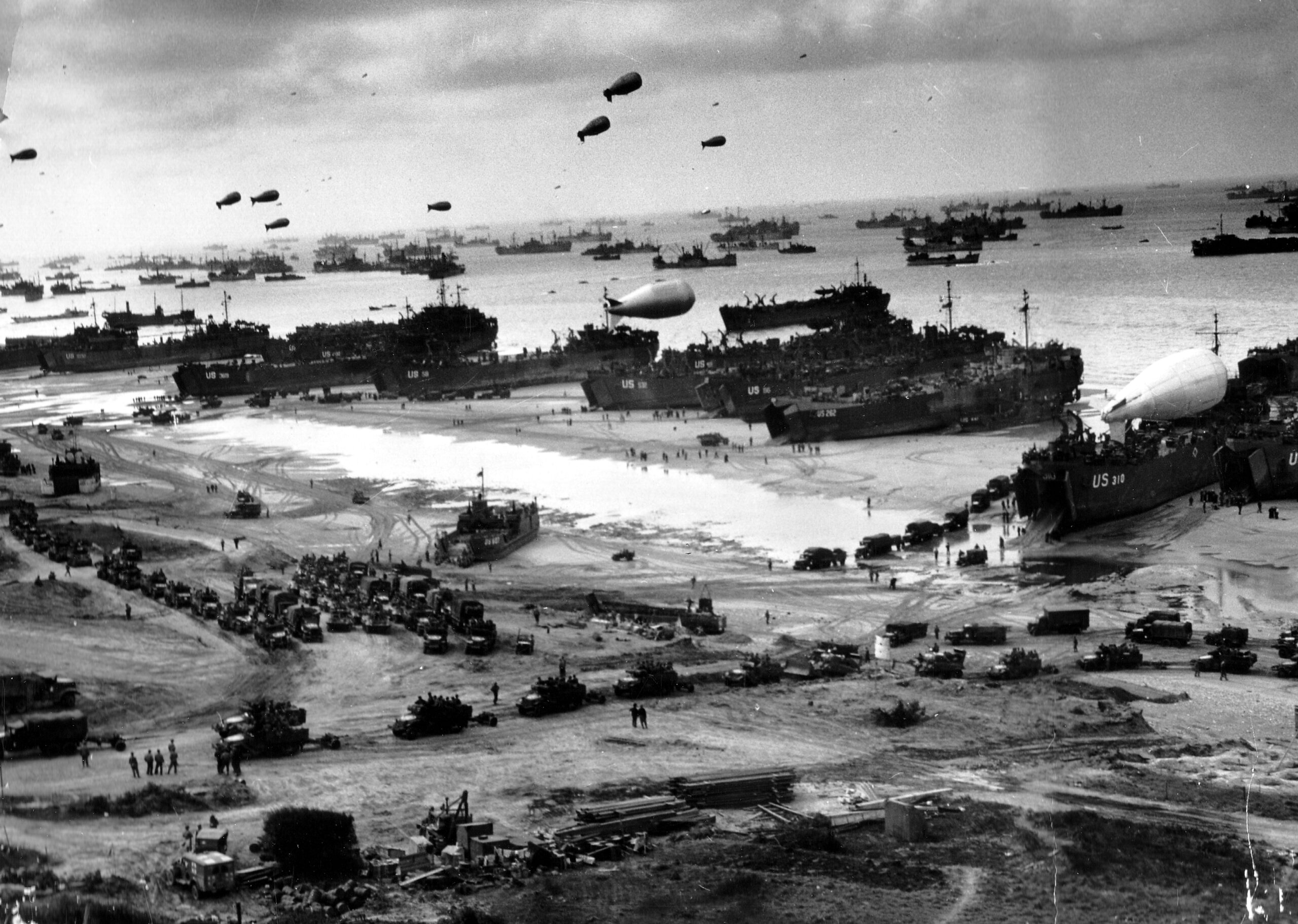
At 6:30 AM on June 6, Allied soldiers began storming the beaches under heavy fire. The bravery shown by infantry, paratroopers, and naval crews cannot be overstated.
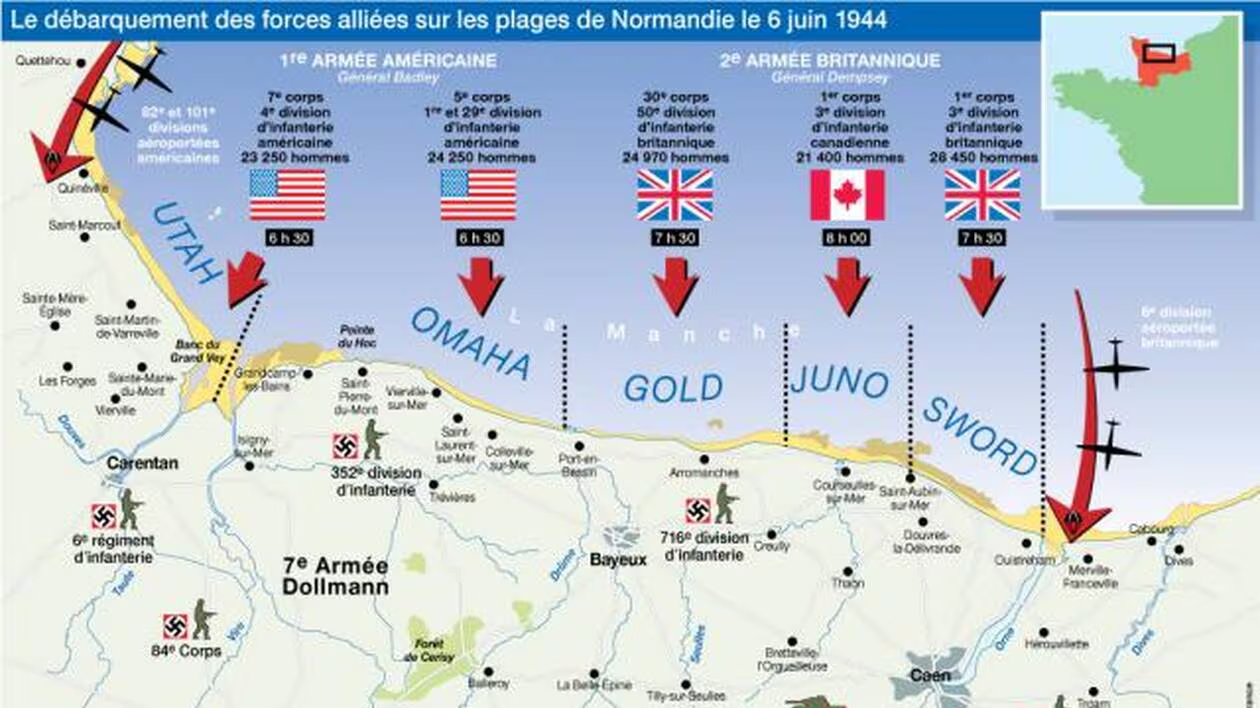
- Utah Beach (American):
- Faced lighter defenses but dealt with challenging tides and landing obstacles.
- Despite confusion in landings, units quickly secured exits off the beach.🇺🇸
- Omaha Beach (American):
- Perhaps the most notorious—heavily fortified by German defenses.
- Soldiers endured intense machine-gun and artillery fire. Casualties were high, yet small units fought valiantly, scaled bluffs, and cleared obstacles. 🇺🇸
- Gold & Sword Beaches (British):
- British Commandos and infantry encountered minefields and concrete bunkers.
- By late afternoon, both beaches were under Allied control, thanks to dogged effort and naval gunfire support. 🇬🇧
- Juno Beach (Canadian):
- Canadians faced fierce resistance from the German 716th Infantry Division.
- Despite heavy casualties, Canadian forces punched through to secure key villages, paving the way for inland advances. 🇨🇦
By day’s end, the Allies had landed over 156,000 troops, with roughly 10,000 casualties (including over 4,000 confirmed dead). The beaches had been secured, but the battles to come would be equally brutal.
3. Remembering the Fallen: Stories of Courage 🌹
Behind every statistic lies a human story—young soldiers who volunteered or were drafted; medics who risked everything to save lives; sailors and airmen keeping supply lines open. Here are just a few examples:
- Lieutenant John Waters (Canada):
At age 20, Waters led a platoon ashore at Juno Beach. Despite being wounded, he refused evacuation to guide reinforcements to an embattled sector, helping thousands break through German lines. 🍁 - Sergeant Edward “Ed” Carter (United Kingdom):
A Royal Engineers sapper, Carter cleared mines under relentless bombardment at Sword Beach. His actions saved dozens of lives and allowed tanks to roll ashore. 🇬🇧 - Private Joseph “Joe” Simpson (United States):
An infantryman at Omaha Beach, Simpson single-handedly silenced a German machine-gun nest using grenades. Afterward, he tended to wounded comrades until medics arrived. 🇺🇸
These are but a fraction of the countless acts of valor on D-Day. Each soldier carries a name, a story, and a family who waited anxiously for news. When we say “Lest We Forget,” we honor not just a battle, but the souls who gave everything for a better world. 🕊️
4. Honouring the Heroes: Ceremonies and Memorials 🎖️
Since 1944, nations allied on D-Day have held annual ceremonies to pay their respects. Key moments include:
- Normandy American Cemetery (Colleville-sur-Mer, France):
Overlooks Omaha Beach, containing nearly 10,000 white marble crosses and Stars of David. Each year on June 6th, wreaths are laid, and memorial plaques are unveiled. - Juno Beach Centre (Courseulles-sur-Mer, France):
Canada’s official museum and cultural center commemorating the sacrifice of Canadian forces. Interactive exhibits, personal artifacts, and educational programs help visitors connect with history. - Gold Beach Memorial (Asnelles, France):
A stone monument listing the names of British, Norwegian, and other Commonwealth soldiers who fell on Gold Beach. Flower-laying ceremonies are held at dawn. - Dover Castle (United Kingdom):
The Churchill War Rooms and nearby memorials honor the strategic planning behind Overlord. Local communities also host parades and veterans’ reunions. - Normandy Landings Museum (Port en Bessin):
Exhibits focus on naval operations and underwater salvage of sunken ships from the invasion. Models, artifacts, and first-hand accounts bring the story to life.
Emotional speeches, flyovers, and moments of silence are hallmarks of these events, reminding us that freedom often comes at a tremendous cost. 🎗️
5. Keeping the Memory Alive: How You Can Honour D-Day 🕯️
Even decades later, it’s our duty to ensure younger generations learn from the sacrifices made on June 6, 1944. Here are actionable ways to honour D-Day:
- Visit a Memorial or Museum:
- If possible, plan a trip to Normandy’s beaches and cemeteries. Experiencing the terrain firsthand is deeply moving.
- Local museums and veterans’ associations often host lectures, film screenings, and school programs—check community calendars for events.
- Share Personal Histories:
- Record oral histories from family members who served or remember relatives who did.
- Write blog posts, social-media tributes, or even letters to local newspapers about personal connections to D-Day. 📖✍️
- Educate the Next Generation:
- Volunteer to speak at schools or youth organizations about WWII and the importance of remembering history.
- Donate books or sponsor history trips that focus on WWII-era education. 🎓🏫
- Participate in Ceremonies:
- Attend local or national D-Day commemorations on June 6th. Post photos or live-blog highlights to raise awareness.
- Lay wreaths or flowers at war memorials in your community, even if there’s no official ceremony. 🌼
- Support Veteran Causes:
- Contribute to nonprofits aiding WWII veterans, such as Honor Flight Network or local veterans’ homes.
- Write letters, send care packages, or volunteer time at VA hospitals and veteran support centers. 🎁💌
By taking these steps, we breathe new life into the past—ensuring that the bravery shown on those Normandy beaches continues to inspire future generations. 🔥
6. Lessons from D-Day: Unity, Sacrifice, and Hope 🌱
Beyond the historical facts and numbers, D-Day teaches us universal lessons:
- Unity in Purpose:
Nations with diverse cultures and languages came together under a single goal: defeat tyranny. Today, global challenges—climate change, pandemics, social injustice—demand similar unity. 🤝 - Sacrifice for Freedom:
Soldiers, sailors, and airmen willingly risked and, for many, gave their lives. Their sacrifice reminds us that privileges we often take for granted—voting, free speech, movement—were not guaranteed. 🌍 - Hope Amid Adversity:
Faced with fortified defenses and nearly impossible odds, Allied troops pressed on. Their courage is a beacon of hope: even when obstacles loom large, collective resolve can prevail. 🌟
As we reflect on these lessons, let us commit to building a world that honours sacrifice by striving for compassion, justice, and peace.
On D-Day, June 6, 1944, soldiers from many Allied nations participated in the largest amphibious invasion in history — Operation Overlord, the opening of the Battle of Normandy. Here’s a detailed breakdown of the nations involved and the approximate number of troops that landed or supported the invasion on that day.
🇺🇸 United States
-
Troops landed on D-Day: ~73,000
-
23,250 at Utah Beach
-
34,250 at Omaha Beach
-
Thousands more in airborne divisions (101st and 82nd Airborne)
-
-
Notable units:
-
1st and 29th Infantry Divisions (Omaha)
-
4th Infantry Division (Utah)
-
82nd & 101st Airborne Divisions (parachuted inland overnight)
-
🇬🇧 United Kingdom
-
Troops landed on D-Day: ~61,715
-
25,000+ at Sword Beach
-
24,970 at Gold Beach
-
Paratroopers from the 6th Airborne Division landed east of Caen
-
-
Notable units:
-
3rd Infantry Division
-
6th Airborne Division (Pegasus Bridge)
-
🇨🇦 Canada
-
Troops landed on D-Day: ~14,000
-
All at Juno Beach
-
-
Notable units:
-
3rd Canadian Infantry Division
-
Canadian paratroopers (1st Canadian Parachute Battalion with British forces)
-
🇫🇷 Free France
-
Troops landed or supported D-Day: ~177 commandos
-
Known as the Kieffer Commandos, landed with British at Sword Beach
-
-
Free French Forces also supported later stages of the Normandy Campaign.
🇵🇱 Poland
-
Polish Navy ships supported landings
-
Polish 1st Armoured Division would land later in the Normandy campaign
-
Polish pilots served in RAF squadrons providing air cover
🇳🇴 Norway
-
Norwegian Navy vessels supported the invasion
-
2 destroyers and 4 other vessels
-
-
Norwegian forces fought under British command
🇳🇱 Netherlands
-
Dutch Navy vessels, including gunboats, supported the landing
-
Dutch pilots served in RAF squadrons
🇧🇪 Belgium
-
Belgian troops and commandos participated with British forces
-
Belgian pilots flew in RAF squadrons
🇨🇿 Czechoslovakia
-
Czech pilots flew Spitfires in RAF squadrons supporting D-Day
🇬🇷 Greece
-
The Greek Navy contributed several ships to the naval operations on D-Day
🇳🇿 New Zealand, 🇦🇺 Australia, 🇿🇦 South Africa, 🇮🇳 India, and other Commonwealth Nations
-
These nations had airmen, sailors, and medical staff in support roles
-
Many served under British command in various capacities
🪖 In Total:
Allied Nations with soldiers, sailors, or airmen involved in D-Day included:
- 🇺🇸 United States
- 🇬🇧 United Kingdom
- 🇨🇦 Canada
- 🇫🇷 Free France
- 🇵🇱 Poland
- 🇧🇪 Belgium
- 🇳🇴 Norway
- 🇳🇱 Netherlands
- 🇨🇿 Czechoslovakia
- 🇬🇷 Greece
- 🇳🇿 New Zealand
- 🇦🇺 Australia
- 🇿🇦 South Africa
- 🇮🇳 India (under British command)
Conclusion 🎉
D-Day: Remembering and Honouring is more than an anniversary—it’s a testament to human resilience, collaboration, and selflessness. On June 6th each year, we stand united in gratitude for the heroes who braved uncertain waters and fortified beaches so that freedom could flourish. 🌊🕊️
Let us carry their legacy forward: share their stories, attend ceremonies, and teach future generations about the true cost of liberty. In doing so, we ensure that their voices—once silenced by war—resonate louder than ever.
🇫🇷🇺🇸🇬🇧🇨🇦🇵🇱🇧🇪🇳🇴🇳🇱🇨🇿🇬🇷🇳🇿🇦🇺🇿🇦🇮🇳
Lest We Forget!
🌐 Official Memorial & Museum Sites
-
The National D‑Day Memorial (Bedford, Virginia): A comprehensive site featuring virtual programming, oral histories, educational materials, and a digital library — ideal for learning and sharing tributes dday.org.
-
Historic Sites of the Battle of Normandy (Bayeux Museum): Learn about key locations like the D‑Day beaches and military cemeteries, including background info and visitor guidance bayeuxmuseum.com.
-
Spirit of Normandy Trust: Features thousands of eyewitness accounts from WWII veterans and educational links — a powerful resource for personal stories and inspiration spiritofnormandy.org.uk.
-
Imperial War Museums – “10 Facts About D-Day You Need To Know”: A reliable summary plus deeper context on the operation, its magnitude, and its impact iwm.org.uk.
🛣️ Travel & Visitor Guides
-
Destination WWII – 7 Best D‑Day Sites to Visit in Normandy: A curated list of top historical sites to see if you’re planning a one‑day tour destinationwwii.com.
-
Normandie‑tourisme – 81st Anniversary of D‑Day: Information about 2025 commemorations and related peace and reconciliation events en.normandie-tourisme.fr.